
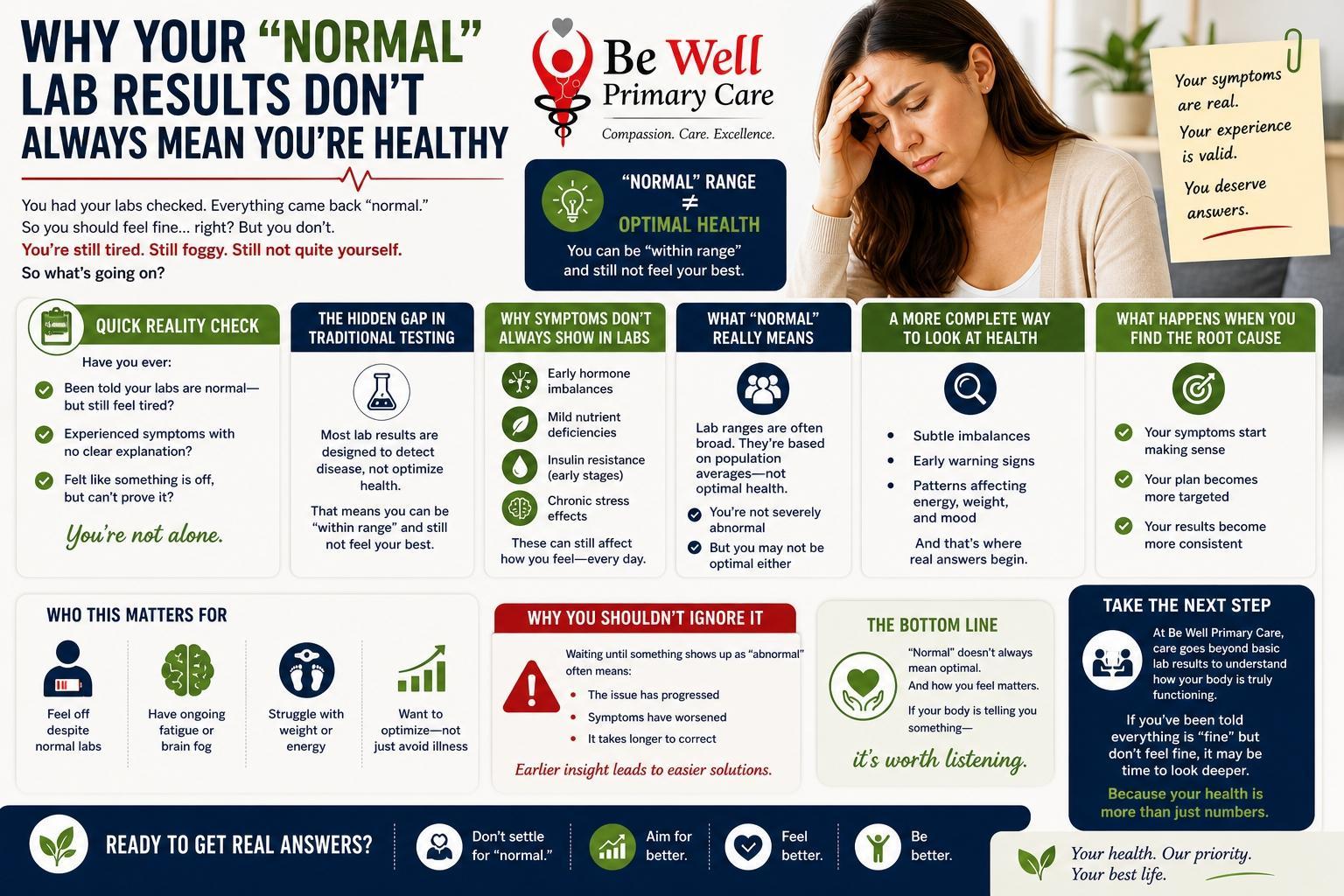
You had your labs checked.
Everything came back “normal.”
So you should feel fine… right?
But you don’t.
You’re still:
- Tired
- Foggy
- Low on energy
- Not quite yourself
So what’s going on?
The Hidden Gap in Traditional Testing
Most lab tests are designed to detect disease — not optimize health.
That means you can technically be:
- “Within range”
- “Normal”
- “Fine” on paper
…and still not feel your best.
What “Normal” Really Means
Lab reference ranges are often broad and based on population averages — not optimal health.
So when your results come back “normal,” it may simply mean:
- You’re not severely abnormal
- But your body may still not be functioning optimally
There’s a difference between surviving and thriving.
Quick Reality Check
Have you ever:
- Been told your labs are normal but still feel exhausted?
- Experienced symptoms with no clear explanation?
- Felt like something is “off” but couldn’t prove it?
You’re not alone.
Why Symptoms Don’t Always Show Up in Labs
Many common health concerns may not immediately appear in standard testing, including:
- Early hormone imbalances
- Mild nutrient deficiencies
- Early insulin resistance
- Chronic stress effects
Even subtle imbalances can affect how you feel every day.
The Problem With “You’re Fine”
Hearing “everything looks normal” can be frustrating.
Because:
- Your symptoms are real
- Your experience matters
- But you’re often left without answers
That gap causes many people to stop searching for solutions.
A More Complete Approach to Health
Instead of only asking:
“Is something wrong?”
A better question may be:
“Is everything functioning optimally?”
Looking deeper can provide a more complete picture of your health.
What Deeper Evaluation Can Reveal
When you go beyond basic lab work, you may uncover:
- Subtle imbalances
- Early warning signs
- Patterns affecting energy, mood, focus, and weight
And that’s often where real answers begin.
What Happens When You Find the Root Cause
When you stop relying only on “normal ranges” and start understanding how your body is functioning:
- Your symptoms begin to make sense
- Your care plan becomes more targeted
- Your results become more consistent
Who This Matters For
This may be especially important if you:
- Feel “off” despite normal labs
- Experience ongoing fatigue or brain fog
- Struggle with energy, focus, or weight
- Want to optimize your health — not just avoid illness
Why You Shouldn’t Ignore It
Waiting until something becomes officially “abnormal” often means:
- The issue has progressed
- Symptoms have worsened
- Recovery takes longer
Earlier insight often leads to easier, more effective solutions.
The Bottom Line
“Normal” doesn’t always mean optimal.
And how you feel matters.
If your body is telling you something, it’s worth listening.
Take the Next Step
At Be Well Primary Care, we look beyond basic lab results to better understand how your body is truly functioning.
If you’ve been told everything is “fine” but still don’t feel your best, it may be time to look deeper.
Because your health is more than just numbers.
Ready to Get Real Answers?
Don’t settle for “normal.”
- Aim for better
- Feel better
- Be better